Even though I never post here (or at least haven't in eight years), I think it's the appropriate place to say that I have been playing lately. I try to pull the guitar out for 20 minutes or so during the day, and I play through tunes, aiming to memorize them, and lately I've also been working on patterns in the Jerry Coker and Oliver Nelson books.
I'm working on comping with those tunes here and there. I guess it's ironic that I got started with high-school jazz band rhythm guitar a bazillion years ago, but I feel like my jazz accompaniment isn't anywhere near where it needs to be.
Even though I'm mostly playing single-note versions of tunes, my aim is to work on a somewhat chordal approach, or maybe a solo guitar approach of some kind. I know in my head what I want to play. It's just the matter of figuring it out on the guitar.
Sunday, August 04, 2019


Saturday, September 03, 2011
I feel like playing again
It's been awhile. I'm tiring of things electronic.
Not sure how I feel about things electric.
But I felt like picking up the guitar. I'm thinking about swing on the steel-string acoustic.
I have a couple PDFs of classic Eddie Lang methods to work with, but as always it would probably be better to learn some tunes.
Not sure how I feel about things electric.
But I felt like picking up the guitar. I'm thinking about swing on the steel-string acoustic.
I have a couple PDFs of classic Eddie Lang methods to work with, but as always it would probably be better to learn some tunes.
Thursday, January 03, 2008
New Ted Greene tribute CD
I've gotten a postcard about the new Ted Greene tribute CD, but I haven't done anything about it yet (the year is young, the end of it busy and otherwise frought).
I continue to think Jake Shimabukuro is one of the best instrumentalists out there
And on the ukulele, no less. Check out the videos on his page, plus the many videos on YouTube.
This guy really knocks me out. I don't see too many people on any instrument doing what he does.
This guy really knocks me out. I don't see too many people on any instrument doing what he does.
This page lost its counter when I updated the template
The new Blogger has great templates -- you can move stuff all around. Since I haven't bothered "tagging" any of the entries, I can't do a "tag cloud," and I'm not even sure Blogger even offers it.
And while I have started a tech-related WordPress blog, I still have a very good feeling for the Blogger service and its interface. In fact, I have a tech blog of the same name in Blogger. But since I can blog during work hours on the Daily News site, most of my effort continues to go into Click, my Daily News blog on technology, about 99 percent of which has to do with open-source software, primarily Linux, with a smattering of BSD, other applications and just a little bit of Windows and Mac info.
But I've gotten the itch to start playing again. Gotta figure out the next step. (Picking up the box is probably the thing to do, don't you thing?)
And while I have started a tech-related WordPress blog, I still have a very good feeling for the Blogger service and its interface. In fact, I have a tech blog of the same name in Blogger. But since I can blog during work hours on the Daily News site, most of my effort continues to go into Click, my Daily News blog on technology, about 99 percent of which has to do with open-source software, primarily Linux, with a smattering of BSD, other applications and just a little bit of Windows and Mac info.
But I've gotten the itch to start playing again. Gotta figure out the next step. (Picking up the box is probably the thing to do, don't you thing?)
Friday, October 26, 2007
The Ted Greene page is really coming along
I haven't been over to the Ted Greene page lately, but it has a whole lot more content than the last time I checked. The site has a bit of a strange design -- you need to click a few more times than you'd think, but it's very much worth it.
There's lots of audio and video, plus quite a few lesson sheets and tunes in PDF form. Even though this stuff is on the Web, I'd love to see some released in book and CD/DVD form.
Barbara, if you see this, you are doing a great job.
There's lots of audio and video, plus quite a few lesson sheets and tunes in PDF form. Even though this stuff is on the Web, I'd love to see some released in book and CD/DVD form.
Barbara, if you see this, you are doing a great job.
Song I heard today that I want to play
"Play That Funky Music, White Boy"
Too cliche? Too obvious?
I say no.
Too cliche? Too obvious?
I say no.
Blog still seems to hold up
A look at the stats shows that 10 to 30 people a day hit this blog.
The tech blog I do for the Daily News draws between 100 and 200 on a bad day, and 300 to 600 when I get a good link on another blog or site. On a really good week, meaning a good link during a heavy tech-news period, it can go up to 1,000 or 2,000 a day. That hasn't happened in awhile.
But I'm happier here with 30 a day than I am over there with 200.
On a related note, I'm thinking of moving this blog over to WordPress. Besides being a newer, ostensibly better service, WordPress will allow this blog to be moved over, supposedly in its entirety, and will then allow backups to XML files. I have no idea whether or not Blogger supports this same feature, but I'd like to find out.
One thing's for sure: Writing on Blogger beats the hell out of doing it on Movable Type.
The tech blog I do for the Daily News draws between 100 and 200 on a bad day, and 300 to 600 when I get a good link on another blog or site. On a really good week, meaning a good link during a heavy tech-news period, it can go up to 1,000 or 2,000 a day. That hasn't happened in awhile.
But I'm happier here with 30 a day than I am over there with 200.
On a related note, I'm thinking of moving this blog over to WordPress. Besides being a newer, ostensibly better service, WordPress will allow this blog to be moved over, supposedly in its entirety, and will then allow backups to XML files. I have no idea whether or not Blogger supports this same feature, but I'd like to find out.
One thing's for sure: Writing on Blogger beats the hell out of doing it on Movable Type.
It's been a long 10 months
I haven't written here in a long time. Not much has been happening in the musical realm. The time I do have has been spent working on computers and blogging about it. That sort of thing comes easier. Picking up an instrument I haven't picked up in months and months, trying to relearn what I've forgotten and learn what I never knew is a daunting prospect.
I even worried about the blog being called "Jazz Guitar Journey," because the direction I'm going in remains instrumental and solo but is diverging away from the jazz repertoire. Looking at the long term (and the way I'm going, there is no short term), I'm going to keep the name. If I ever do shift my focus back here, there's no telling what will happen.
Long layoffs from playing. They don't happen to everyone, but they do happen to plenty of us. Some go years or decades without playing. The challenge of returning to the box is one that isn't written about much.
I've seen a couple of players lately. One at a wedding, another on the street in Santa Monica. Neither were all that great, but just seeing people playing out is inspiring.
Especially when it comes to street performers, they toil in obscurity that is anything but relative. People rarely stop, and there's not a lot of attention or respect paid. That all changes when the player is really good and knows how to perform. But a lot of solo guitar playing is meant to be backgroundish. You can still catch ears with good playing.
Time for a Ted Greene reference. I've read plenty of stories about how Ted liked to play parties. He's set up and play, knowing full well what the deal was. Of course, somebody with Ted's talent and command of hundreds or thousands of tunes (much like the great piano players who do this sort of thing, but unlike most guitarists) could draw in a single person or a whole room as much as he liked. Invariably, the stories come around to the person in the room (the teller of the story) who is a huge fan and can't believe that a then-living-legend is playing the party.
I guess what I'm trying to say is that a guy like Ted Greene was so unique, but that shouldn't be the case. Guitarists, like pianists, should know how to play tons of tunes by themselves and be able to do so for a few hours at a crack.
And here I am, not playing at all for months. I couldn't fake my way through a whole tune, much less 10, 20 or more.
It all begins somewhere. At the beginning.
I even worried about the blog being called "Jazz Guitar Journey," because the direction I'm going in remains instrumental and solo but is diverging away from the jazz repertoire. Looking at the long term (and the way I'm going, there is no short term), I'm going to keep the name. If I ever do shift my focus back here, there's no telling what will happen.
Long layoffs from playing. They don't happen to everyone, but they do happen to plenty of us. Some go years or decades without playing. The challenge of returning to the box is one that isn't written about much.
I've seen a couple of players lately. One at a wedding, another on the street in Santa Monica. Neither were all that great, but just seeing people playing out is inspiring.
Especially when it comes to street performers, they toil in obscurity that is anything but relative. People rarely stop, and there's not a lot of attention or respect paid. That all changes when the player is really good and knows how to perform. But a lot of solo guitar playing is meant to be backgroundish. You can still catch ears with good playing.
Time for a Ted Greene reference. I've read plenty of stories about how Ted liked to play parties. He's set up and play, knowing full well what the deal was. Of course, somebody with Ted's talent and command of hundreds or thousands of tunes (much like the great piano players who do this sort of thing, but unlike most guitarists) could draw in a single person or a whole room as much as he liked. Invariably, the stories come around to the person in the room (the teller of the story) who is a huge fan and can't believe that a then-living-legend is playing the party.
I guess what I'm trying to say is that a guy like Ted Greene was so unique, but that shouldn't be the case. Guitarists, like pianists, should know how to play tons of tunes by themselves and be able to do so for a few hours at a crack.
And here I am, not playing at all for months. I couldn't fake my way through a whole tune, much less 10, 20 or more.
It all begins somewhere. At the beginning.
Monday, January 22, 2007
Not that I've been doing anything lately
... but between 10 and 30 people a day stop by this blog. That's more than my other blogs, which get updated way more often.
I guess it speaks to the popularity of jazz guitar among Web surfers because most of you arrive here as the result of search engines. Since Google is so Blogger-friendly, the former owning the latter and all, I come up pretty high in a lot of searches.
Lately I've been spending more time on writing, blogging, working on my various computing projects (Mac, PC and now Palm) doing my "real" paid work at the Daily News and spending time with my family ... not necessarily in that order.
But my musical future -- and very likely a whole new blog to go with it -- will being unfolding at some point soon.
At least I hope.
While here, I heard the new Sheryl Bailey live organ trio record, and it was pretty good. She's such an expressive player -- she can really speak through her instrument. I do have her instruction book, "The Chord Rules," and I have to confess that it seemed a little simplistic, like there wasn't enough there to really get you going as an improviser -- or maybe I'm missing the point.
I guess it speaks to the popularity of jazz guitar among Web surfers because most of you arrive here as the result of search engines. Since Google is so Blogger-friendly, the former owning the latter and all, I come up pretty high in a lot of searches.
Lately I've been spending more time on writing, blogging, working on my various computing projects (Mac, PC and now Palm) doing my "real" paid work at the Daily News and spending time with my family ... not necessarily in that order.
But my musical future -- and very likely a whole new blog to go with it -- will being unfolding at some point soon.
At least I hope.
While here, I heard the new Sheryl Bailey live organ trio record, and it was pretty good. She's such an expressive player -- she can really speak through her instrument. I do have her instruction book, "The Chord Rules," and I have to confess that it seemed a little simplistic, like there wasn't enough there to really get you going as an improviser -- or maybe I'm missing the point.
Monday, October 16, 2006
Ed Bickert with Rob McConnell
Just skip to the 4-minute mark for Ed soloing with Rob McConnell's quintet
Nobody can play like Ed.
Nobody can play like Ed.
Marc Sabatella to the rescue
One of the smartest people I've come in contact with on the Internet when it comes to jazz -- and playing music in general -- is Marc Sabatella.
Case in point, a rec.music.makers.guitar.jazz discussion on bebop heds and the David Baker bebop books:
Here's Marc's whole post. The entire thread.
What's funny, also, is that Marc is a pianist, not a guitarist, but he hangs out on RMMGJ because it's got about 20 times the activity of rec.music.makers.jazz. I highly recommend Marc's book, "The Harmonic Language of Jazz Standards," which offers a new way of understanding harmony in the context of playing the standards in a jazz context. Now it's all based on standard Western-style harmonic analysis, but with lots of creative ways to look at and understand that harmony, with the goal being the ability to play a standard tune from musical memory, on the spot, in any key, without ever having seen the lead sheet. It's a lofty goal that I'm pretty sure I'll never reach, but there's plenty to learn from the book nonetheless. And it applies equally to guitar and piano, if you're wondering.
Case in point, a rec.music.makers.guitar.jazz discussion on bebop heds and the David Baker bebop books:
For one thing, it's not like these guys were "using" the bebop scale in
the way we might think about it today. They were using the major and
minors scale, and tossing in some passing tones when it felt necessary.
Baker just codified this practice by putting names on particular
combinations of major and minor scales with passing tones. So one
shouldn't expect to see anything that looks quite as pat as Baker makes
it sound. Sure, beboppers used passing tones all the time, but in a way
MUCH more varied than would appear from learning a small set of fixed
"bebop scales".
Second, I think you'll find more use of this particular devices in
*solos* than in heads, simply because the heads don't tend to have quite
the same types of long streams of eighth notes in which these passing
tones are most effective. Heads are still great to learn to get a
general feel for the language in terms of phrasing and so forth, but if
you really need to see a lot of examples of people using passing tones
in the way Baker describes, look at the solos in the Omnibook (or
transcribe a few yourself). Personally, I don't feel the concept of
adding passing tones to one's lines is so hard to grasp that it really
requires examples in order to be able to do so oneself. Sure you might
come up with something slightly *different* from the ways Bird et all
used passing tones. As far as I am concerned, that's a *good* thing.
Here's Marc's whole post. The entire thread.
What's funny, also, is that Marc is a pianist, not a guitarist, but he hangs out on RMMGJ because it's got about 20 times the activity of rec.music.makers.jazz. I highly recommend Marc's book, "The Harmonic Language of Jazz Standards," which offers a new way of understanding harmony in the context of playing the standards in a jazz context. Now it's all based on standard Western-style harmonic analysis, but with lots of creative ways to look at and understand that harmony, with the goal being the ability to play a standard tune from musical memory, on the spot, in any key, without ever having seen the lead sheet. It's a lofty goal that I'm pretty sure I'll never reach, but there's plenty to learn from the book nonetheless. And it applies equally to guitar and piano, if you're wondering.
Wednesday, October 04, 2006
Ted Greene update
First of all, the Ted Greene tribute Web site is back ... with lists of stuff instead of actual content -- but hey, it's a start.
And check out these videos on YouTube:
"Have Yourself a Merry Little Christmas" from a 2003 seminar (at California Vintage Guitar & Amp in Sherman Oaks, I believe)
"Autumn Leaves" from a seminar at the Musicians Institute (date uncertain to me, but I know it's MI because that's what's printed on the music stand -- note the Tele with single-coil neck pickup)
"Autumn Leaves" part 2
Mannnn. Ted is still the greatest.
And check out these videos on YouTube:
"Have Yourself a Merry Little Christmas" from a 2003 seminar (at California Vintage Guitar & Amp in Sherman Oaks, I believe)
"Autumn Leaves" from a seminar at the Musicians Institute (date uncertain to me, but I know it's MI because that's what's printed on the music stand -- note the Tele with single-coil neck pickup)
"Autumn Leaves" part 2
Mannnn. Ted is still the greatest.
Tuesday, August 22, 2006
Ed Bickert on "Pure Desmond"
 "Pure Desmond," Ed Bickert's first album with the great alto saxophonist, is one of my Holy Grail discs. I think it has Bickert's best recorded sound ever, and I've heard all sorts of explanation as to why it sounds like it does (both pro and con).
One of the best sources is Canadian guitarist and teacher Joey Goldstein, who's very active on rec.music.makers.guitar.jazz. He's answered my questions on this before, but I believe this is the first time he says that Ed Bickert's Telecaster, on "Pure Desmond," could be equipped with the original single-coil neck pickup and not a Gibson humbucker (as seen in the 1980s at left). And Joey also thinks that Ed might have played at his bar mitzvah (whoa!) Also -- Ed had an ES-175:
From:
Joey Goldstein
Date: Sun, Aug 20 2006 12:20 pm
Email: Joey Goldstein...@nowhere.net> Dave M wrote:
Groups: rec.music.makers.guitar.jazz
> I recently got The Paul Desmond Quartet Live (from Toronto) album (the
> one w/ Desmond on the cover looking like Larry King). Bickert's tone is
> warm and clear, and sustaining, and there's something about it--a
> certain openness in the freq range that reminds me a hollowbody. This
> album was recorded in '75. Wasn't he playing the Tele by then? Anyone
> know for sure?
Yes. He was playing the Tele on Pure Desmond as well but I think he may have had the single coil pickup still on it.
I think he switched to the humbucker right after Pure Desmond, but I could be wrong.
Most of the recordings of Ed in existence will have him on the Tele. But I've got a jazz calendar with a pic of the CBC Orchestra, circa 1964 (or possibly earlier), and he's holding a 175.
I think, but I'm not sure, that Ed was in the band that my Dad hired to play at my bar mitzvah. He hired some CBC musicians and I think Moe Koffman was the leader. My friends were all..."That guy plays slow!"....But I said "Yeah, but look at those chords!". I was more into fast playing myself but at least I had the sense to recognize the chords.
-- Joey Goldstein http://www.joeygoldstein.com joegold AT sympatico DOT ca

Keith Murch said Ed's favorite amp was a Standel. (But was it a solid state or tube model?) I have heard good things about the old solid-state Standels. Ed used a Roland Cube-60 for many years, but that amp was first made in the 1980s. For all we know, Ed could've used whatever amp the studio already had. Along the same thread (but not really), rumor is that Rudy Van Gelder's Englewood Cliffs, N.J., studio had a Fender Deluxe amp that all the guitar players used on his sessions. Even today, many guitarists just don't travel with amps. On the road, they use what the venue provides, usually a Fender Twin or Roland JC-120. When he toured as a solo artist, Joe Pass neither brought nor even used a guitar amplifier. He just went through a direct box straight to the board.
Tuesday, August 08, 2006
Get the box out
We've been furiously getting ready for Lulu's 3rd birthday party, and we did windows on Sunday. Not Windows (as in XP) but windows (as in glass). By the afternoon, we decided to have lunch outside since it's finally bearable under the trees in the back yard. After we ate, the girl went directly to playing in the dirt, and I pulled out the box -- the Goya classical -- to noodle around a bit. Nothing too heavy (although I did work on easy tunes just a bit), just tuning it up and playing around a bit -- right-hand fingers, no pick.
It reminds me just how much I love the sound of nylon strings.
Anyhow, the girl -- after hand-washing -- strummed a bit as I fingered some chords, and then we put the guitar away and both played in the dirt for awhile.
But I did get the box out. I've got to get my weekdays together and spend lunch at least a few of those days playing. That's my new goal.
It reminds me just how much I love the sound of nylon strings.
Anyhow, the girl -- after hand-washing -- strummed a bit as I fingered some chords, and then we put the guitar away and both played in the dirt for awhile.
But I did get the box out. I've got to get my weekdays together and spend lunch at least a few of those days playing. That's my new goal.
Tuesday, August 01, 2006
I have a confession to make
I haven't picked up the guitar for a couple of months now. Aside from things at the Daily News getting more and more hectic all the time (I'm blogging over there a ton, too), and the summer's searing heat screwing with my lunchtime practices, I find myself drawn to other pursuits, mostly all the computer-related stuff (as chronicled in This Old Mac and This Old PC).
I've been planning, in my mind, where I want to go with the guitar, and I've been collecting music that I want to incorporate into my solo repertoire. I can imagine, in my mind, how I want it to sound, the approach I want to take (it becomes more rock, less jazz), but none of this involves picking up the box and playing it. I lug around a laptop computer, not a guitar bag.
I think part of this is that I have some long-standing barriers in my playing that I have to break through, and while planning and collecting music for the tunes I want to play, actually getting one of those tunes under my fingers, the whole way through, is what I have to do. Even if it's one tune. I get frustrated: I can't sit down and play a half-hour set of tunes. But I've got to build them up, one at a time. And at this point, I can't really expect to come up with the arrangements on the fly. I'll have to either use a pre-written arrangement or (preferably) come up with my own and stick to it. And even knowing just one tune all the way through in some kind of solo rendition would be huge at this point. Of course that means really knowing that tune. The whole melody and all the chords, along with a good idea theoretically what's going on so I can take it into other keys. Hell, at this point one tune, one key is enough.
I'm thinking that if I make the goals small enough, they won't be so insurmountable that I never even try to achieve them.
Hell, if I can write 200 blog posts, I can learn a couple of tunes. (See, I'm already up to two.)
I've been planning, in my mind, where I want to go with the guitar, and I've been collecting music that I want to incorporate into my solo repertoire. I can imagine, in my mind, how I want it to sound, the approach I want to take (it becomes more rock, less jazz), but none of this involves picking up the box and playing it. I lug around a laptop computer, not a guitar bag.
I think part of this is that I have some long-standing barriers in my playing that I have to break through, and while planning and collecting music for the tunes I want to play, actually getting one of those tunes under my fingers, the whole way through, is what I have to do. Even if it's one tune. I get frustrated: I can't sit down and play a half-hour set of tunes. But I've got to build them up, one at a time. And at this point, I can't really expect to come up with the arrangements on the fly. I'll have to either use a pre-written arrangement or (preferably) come up with my own and stick to it. And even knowing just one tune all the way through in some kind of solo rendition would be huge at this point. Of course that means really knowing that tune. The whole melody and all the chords, along with a good idea theoretically what's going on so I can take it into other keys. Hell, at this point one tune, one key is enough.
I'm thinking that if I make the goals small enough, they won't be so insurmountable that I never even try to achieve them.
Hell, if I can write 200 blog posts, I can learn a couple of tunes. (See, I'm already up to two.)
Wednesday, July 12, 2006
New Jody Fisher album
Jody Fisher has a new album out of solo guitar, called "Wistful Thinking," this time entirely of original compositions. There are extensive samples here.
At $15 each for his most recent two albums, it's quite a bargain -- I think Jody is one of the best solo jazz guitarists out there. He manages to bring a whole host of influences together (Joe Pass, Ted Greene, Lenny Breau, George Van Eps) to create a very musical, flowing presentation. As I've said before, I consider him the heir to Ted Greene, as far as this kind of playing is concerned. I've got to take the plunge at some point and get his solo guitar instruction books/CDs, "The Art of Solo Guitar."
At $15 each for his most recent two albums, it's quite a bargain -- I think Jody is one of the best solo jazz guitarists out there. He manages to bring a whole host of influences together (Joe Pass, Ted Greene, Lenny Breau, George Van Eps) to create a very musical, flowing presentation. As I've said before, I consider him the heir to Ted Greene, as far as this kind of playing is concerned. I've got to take the plunge at some point and get his solo guitar instruction books/CDs, "The Art of Solo Guitar."
Ted Greene site controversy

I followed a link to the Ted Greene memorial site, and it seems that due to a dispute between Ted's siblings and those who run the Web site (including Ted's girlfriend Barbara), the site has been taken down. Only forums remain, where it's pretty easy to follow what happened. Leon White (producer of the "Solo Guitar" LP) and others say lawsuits were threatened, and that led to suspension of the fast-growing compendium of Ted's lesson materials, recordings, etc.
Go here to follow the thread.
If you go through the various parts of the forum, you'll stumble across gems like this. Blogger isn't cooperating when it comes to uploading photos, or I'd post one of the many on the forum here.
Thursday, July 06, 2006
Irving Berlin and D# minor

I knew that Irving Berlin couldn't read or write music, but can't believe this from his Wikipedia entry:
In spite of his musical career, Berlin never learned how to play a piano or read music beyond a rudimentary level. He reportedly was unable to compose in any key other than F-sharp major (or, presumably, D-sharp minor, since he also wrote songs in minor keys) and owned a special piano that mechanically transposed keys while an assistant wrote out the music scores.
He could only play in one key? Since a lot of show tunes modulate like crazy, how did he handle that? Did the "special piano" transpose on the fly somehow?
Here's what Wikipedia says:
A Transposing piano is a special piano which can be adjusted by the player (e.g. with a lever or pedal) to transpose. There are not many in existence, but they have been used, for example, by people whose skills are restricted to playing in certain keys, or by those who need to transpose music, but lack the necessary skill in so doing.
Tuesday, June 20, 2006
Joe Pass -- "For Django"

I finally ordered this -- got a gift certificate for Tower, and it is on "special order," which means it might come someday. Some say Pacific Jazz Joe Pass is the holy grail, and I have to agree that the character of his work for the label in the early '60s is much different from what came later for Pablo in the early '70s and beyond. I already have "Joy Spring," which was recorded live for Pacifi
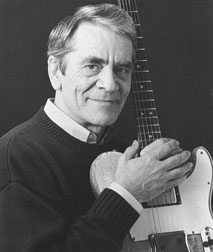
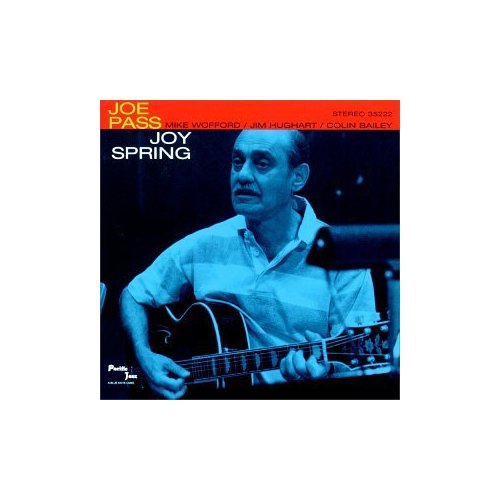 c Jazz in 1964, I believe, and is pretty much a master class in bebop guitar. Both of these records aren't easily available, though both are part of the Mosiac box set, "The Complete Pacific Jazz Joe Pass Quartet Sessions," which costs $80 and is only available direct. For those who may be wondering, neither of these two photos is from the time at which the records were recorded -- '63 and '64. Why can't they use the original artwork, or at least find period-appropriate photos of Joe? I figure the "For Django" shot is from the early '70s, and the "Joy Spring" one is from the '90s. Either way, these are two must-haves for Joe fans, and I'm glad to finally get "For Django."
As far as "Joy Spring" goes, Joe plays a lot slower and more deliberately than he does during the Pablo years. That's one of the reasons I think more players relate to the Pacific Jazz Joe that to the Pablo one -- you can really get a grip (literally, figuratively) on the bebop language for the instrument from "Joy Spring," and it's easy to steal licks off the record. There's some wonderful comping by Joe, too. "Joy Spring" should still be available as a single disc, and it's pretty much a crime that the Joe discs on the label, including "Catch Me" are so often out of print and hard to obtain.
Subscribe to:
Posts (Atom)