Tuesday, June 20, 2006

Joe Pass -- "For Django"


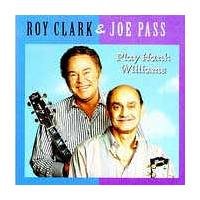
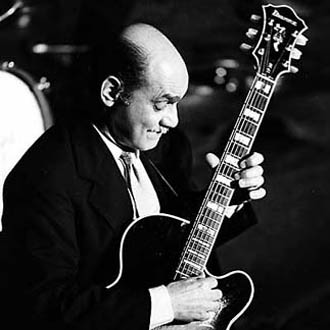
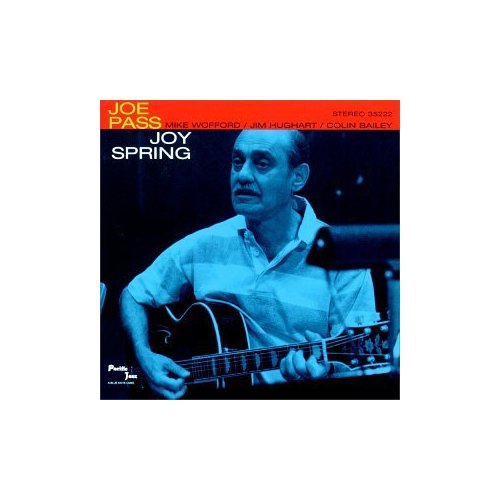
I finally ordered this -- got a gift certificate for Tower, and it is on "special order," which means it might come someday. Some say Pacific Jazz Joe Pass is the holy grail, and I have to agree that the character of his work for the label in the early '60s is much different from what came later for Pablo in the early '70s and beyond. I already have "Joy Spring," which was recorded live for Pacific Jazz in 1964, I believe, and is pretty much a master class in bebop guitar. Both of these records aren't easily available, though both are part of the Mosiac box set, "The Complete Pacific Jazz Joe Pass Quartet Sessions," which costs $80 and is only available direct. For those who may be wondering, neither of these two photos is from the time at which the records were recorded -- '63 and '64. Why can't they use the original artwork, or at least find period-appropriate photos of Joe? I figure the "For Django" shot is from the early '70s, and the "Joy Spring" one is from the '90s. Either way, these are two must-haves for Joe fans, and I'm glad to finally get "For Django."

As far as "Joy Spring" goes, Joe plays a lot slower and more deliberately than he does during the Pablo years. That's one of the reasons I think more players relate to the Pacific Jazz Joe that to the Pablo one -- you can really get a grip (literally, figuratively) on the bebop language for the instrument from "Joy Spring," and it's easy to steal licks off the record. There's some wonderful comping by Joe, too. "Joy Spring" should still be available as a single disc, and it's pretty much a crime that the Joe discs on the label, including "Catch Me" are so often out of print and hard to obtain.

Friday, May 26, 2006

Wednesday, March 29, 2006

Joe Pass and Roy Clark


Google has an hour-long video of Joe Pass and Roy Clark playing together in the studio. I could watch Joe play rhythm all day.

I haven't had the chance to watch the whole thing, but it's a documentary with interviews of both players. Just like Joe said, I always liked Roy's playing -- it was hard to miss him on "Hee Haw" in the '70s and '80s. A very good player, as are many in the country field.

I remember reading somewhere that this was Joe's last session before his death in 1994. If so, it's a nice way to go out -- some very good music here.

Gear notes: Roy is playing a Heritage thin-bodied guitar, probably built custom for him. Joe is playing the special ES-175 that Gibson made for him in the years before his death. It has a slightly thinner body, a rosewood bridge, trapeze tailpiece and only one pickup, which is mounted flush with the neck like on an L4 CES (closer than a tradional 175), and the original Kluson tuners (not replacement Grovers).

Found via the Joe Pass Memorial Hall, where all things Joe can be learned.

It takes GIANT STONES to trade eights with OP


Check out this YouTube.com video of Joe Pass playing with Oscar Peterson. NHOP on bass.

Joe is standing up, playing the Ibanez, and cooking like crazy, which is what you pretty much had to do to keep up with Oscar Peterson.

Joe plays the head of "The Cakewalk" in unison with Peterson -- and check out the section when piano and guitar trade eight-bar phrases.

Another example of Joe Pass, the complete player -- masterful rhythm guitarist, ensemble player and soloist.

Friday, March 17, 2006

John Stowell podcast

For my 40th birthday, (yep, I'm 40 -- FORTY), Ilene got me a video iPod, so I downloaded the John Stowell video podcast from Portland Jazz Jams.

I haven't had a chance to really watch it, but first impressions are that the video and audio are both excellent. They could sell this thing for $24.95 through Mel Bay, and it would hold up very well.

John is playing his Doolin nylon string in front of a black background, and the performance was captured by two cameras -- there are plenty of close-ups of his hands (watching his left hand is a master class in itself), and a few "dissolves" with the views of two cameras at once.

Sound is great. Probably the best thing is that he is playing the nylon string and not an electric with a bunch of effects, which make some of his earlier recordings less than ideal.

I'll have to spend some time watching the whole thing, but this is a definite must for those who love solo jazz guitar. John Stowell is truly an original player who shouldn't be missed, and he does, in fact, sound better than ever.

Wednesday, February 08, 2006

Christopher Woitach

Update: Christopher e-mailed me to clarify the speaker cabinet used on the audio podcast I talk about below.


I found out about Christopher Woitach when looking up John Stowell. They did a duo album, and I am really knocked out by Christopher's playing. There are some full tracks here on his Web site, but I came across this great Portland, Ore.-based jazz podcasting site. They have an unwieldy video podcast of John Stowell -- the thing's something like 150 MB.

But well in the realm of downloadable ability is this audio podcast of a Christopher Woitach live date. He sounds so good and is very creative in his lines.

(Normal people, stop reading here.)

For the geeks, he's playing a new D'Angelico NYL-2, which I think has a solid pressed spruce top. He could be playing the model with a carved top -- who knows? -- but the thing sounds like an L5, and he has been known to useused a Clarus amp and Raezer's Edge Stealth 10 cabinet a cabinet made by Daedalus (in Ferndale, Wash.) that has two 8-inch and two 5-inch speakers. I think it's this one. His sound is very natural and almost a bit acoustic. And he can really play, which always helps.

More update: Christopher also reports that he is now recording a new CD, to be titled "Dead Men (Are Heavier Than Broken Hearts)," which he calls "a Raymond Chandler tribute, of sorts." I'll be looking forward to it because I think that mood and theme can really add to the enjoyability of a recording.

Thursday, February 02, 2006

A John Stowell lesson

Everybody always talks about how great John Stowell is, and I agree. What's great about John is that when he does a duo or group record, everybody else on the project is at the same high level, and I've discovered quite a few good players by listening to his records.

I've also heard greate things about his teaching methods, and he had a hard-to-find series of three videos out years ago, but no books. But now Mel Bay is bringing out this material on DVD (Yes! I can watch it on my Mac!), and they posted an eye-opening lesson on their site, which includes a 15-minute video clip.

The lesson is on substitutions using triads, and it shows how, over a C Major 7 chord, you can play a C, D, E, F or G major triad over the chord, detailing what you will get. For me, it illustrates both the freedom and the possibilities of jazz improvisation. If you know where you are in the tune, you have MANY places to go.

I'll have to try this out. I understand how the D major triad gives you the 9th (D), the #4 (F#) and the 6th (A); but I'm a little fuzzy on why you'd play the E major triad, since you get the 3rd (E), then the #5 (G#) and the 7th (B). I didn't think that the #5 was all that common or desirable over a major chord, and since the iii chord in the key (in C, that's E minor) is such a good choice, why you'd want to play the III (E major) anyway?

"It's just nice to have the variety," Stowell says in the video, and it helps to have some extra "colors in your palette" to play over the Maj 7 chord if it comes up a lot in a tune.

Anyway, the video looks really good, John is VERY clear and methodical, and at $19.95 for the DVD and 40-page book, this is another one on my list to check out.

Wednesday, February 01, 2006

Jake Hanlon, another jazz guitar master's degree student


In the comments for Improvisations on a Theme, I came across Jake Hanlon (there's a blog there, among other things), another guitarist pursuing a master's degree, in this case at the mighty University of North Texas. He earned his undergraduate degree at Saint Francis Xavier University in Antigonish, Nova Scotia, and he now studies and plays at UNT with his brother Josh, a pianist (yes, they both attend UNT and have a group together as well).

What seems immediately good about Jake's situation is that he gigs a whole lot, both with UNT ensembles and his own groups.

His web site also offers lessons, which I see as another good sign because graduate school, even for music, is not all about performance but equally and often more concerned with pedagogy (i.e. teaching) and research so these guys have the option/chance of a career in academia in addition to performing (and composing, etc.).

I won't go in detail at this point about what I think of studying jazz at the undergraduate and graduate levels because I really don't know enough about it. My own experience with university-level music study was one and a half years in the classical guitar BM program at California State University Northridge. I certainly learned a lot in that time about music, the nature of working hard, and about life in general. One of the things I learned was that I didn't want to pursue a career in music. After a year in, I didn't think I was good enough, and I didn't have enough desire to really commit to music as a career. I also had other interests I couldn't pursue under the crush of music studies.

I considered going into science, but humbling grades in calculus made me think twice about that, and at that point I knew I wanted to study literature and writing, and at the end of my second year at CSUN, I transferred to UC Santa Cruz, eventually graduating with a BA in comparative literature. I've spent time since then at various distances from playing music and have returned somewhat stronger in recent years, more writing about it than doing it, but that's just where I'm at right now. In the early '80s, before CSUN, I played big-band jazz in high school, but my abilities and knowledge regarding improvisation were rudimentary at best. I'm getting there slowly -- make that very slowly -- as a hobbyist now, with my goal to be getting to a level where I'm able to play out a little, whether it's jazz or some other kind of music that fits where I'm at.

But back to graduate school. I do admire these guys, and especially when they supplement their studies with playing gigs, I have a feeling they're headed in the right direction. But jazz in particular is a difficult area of music to pursue. It helps to be really, really good on your instrument, and it doesn't hurt to be able to play all styles and be ready to gig with just about any kind of performer at a moment's notice (I think that's the focus of USC's Studio/Jazz Guitar program).

Tuesday, January 31, 2006

Jason, a jazz guitarist in graduate school

Found this on rec.music.makers.guitar.jazz -- a graduate student in jazz guitar is blogging on his experiences at Improvisations on a Theme. It's in the extremely early stages but just might offer some valuable insight into what's going on at the university level in jazz studies.

I plan to keep an eye on it, and it's going on the blogroll here in case you (or I) need to find it.

Friday, January 27, 2006

Jody Fisher and "The Art of Solo Guitar"


On my to-buy list is Jody Fisher's "Impromptu," samples of which are available here. Jody has quite a career writing instruction books for Alfred Publishing, and his jazz methods are some of the best around (and I make that claim about very few of the books I see).

While Jody is a prolific teacher and author, he also sounds fantastic. He lives somewhere in Southern California's desert and gigs a lot in the Palm Springs and Lake Arrowhead area. He's the closest player out there to the sound of Ted Greene in terms of great chordal voice leading, strong melody and use of artificial harmonics (which Ted took from Chet Atkins, Tal Farlow and Lenny Breau and refined).

I've never worked out of Jody's books before, but he has a new two-volume series, available from his Web site as well as Jamey Aebersold's site, called "The Art of Solo Guitar," which aims to teach the skills to IMPROVISE as solo guitarist, creating arrangements and playing over changes on the fly (as opposed to performing a previously written-out, unchanging version).

While there are hundreds of books devoted to teaching single-line improvisation, both specific to the guitar and for other (or all) instruments and perhaps a dozen on how to play solo guitar, there are very few that bring solo guitar and improvisation together. It's like the old analogy about giving a man a fish and he'll eat for a day, but give him a fishing pole (and a supply of hooks, bait and fishing line) and he'll eat for a lifetime. I think there's value in both the fish and the pole. You can still get a lot out of an arrangement of a standard tune and derive ideas and approaches that will work with other songs, and that way at least you have something to play for people.

But building the nuts and bolts of a technique that can be applied to every tune you see, man that is one hell of a fishing pole.

Monday, January 16, 2006

How badly do you want to play that tune?

That's the question I'm asking myself regarding the two posts below on chord-melody arrangements. I'm at the point where I don't want to put time into learning tunes that I'm not excited about. So that makes me less than excited about putting work into the pre-written arrangements I mentioned earlier. Forgetting transposition into other keys, I want to at least begin by playing in the songs' original keys. So I need to keep working on "How High the Moon," and think of some modern tunes that could be done solo on the guitar. I'm looking through a fake book now for candidates and trying to pick things that don't modulate so much.

In other news, I pulled all the guitars out last night to see how they're doing physically. Is anything falling apart more now than before? The Goya classical's back is still coming off near the bottom, but that's pretty much status quo. Everything else checks out. The ES-175 bridge is still tilting slightly (turns out that string pull can do that with a floating rosewood archtop bridge), so I'll have to loosen the strings and straighten it out. I want to measure first so I have a snowball's chance of getting the intonation set right, since that guitar is surprisingly flawless in that regard (unusual for a fixed, compensated bridge).

Saturday, January 07, 2006

Chord melody by Van Moretti

I believe an arrangement by Van Moretti has appeared in every issue of Just Jazz Guitar I have ever received. My philosophy has been that it is better to make up my own arrangements from the lead sheet of a tune because then it will perfectly suit the skill level I'm at and will make the most sense to me, both harmonically and technically. And as I get a bigger chordal vocabulary, the renditions of the tunes get better. The other thing I've been trying to do is play the tunes in their original keys.

It hasn't been working out so good. I don't spend nearly enough time, and I've been looking for a style of arranging for the guitar that fits where I'm at and how I want to play.

Some of the most intriguing arrangements are those of Robert Conti, who also has a tune in just about every issue of JJG. He does it all with chord grids above the staff, with melody notes below for reference (and with little rhythmic notation, as he encourages players to call upon their own interpretation in that regard). I especially like his reharmonizations, and he does have two books that focus on that subject. He no longer offers books of chord-melody arrangements, but the old JJGs are a good source.

Still, the Conti arrangements are not working so well for me at the moment. I can't say I won't go back to them. They have the aformentioned quality in their reharmonization, and they can also help with voice leading. But I just tried Moretti's "More Than You Know," and that sounds very nice. It's in the key of C, which is a very easy key for guitar (right up there with A, G and D). The original is in Eb. Hmmm ... don't know what I think of that, but it is a very nice arrangement, and I can make the melody pop out of it right away. Sometimes it's hard to make the melody come out of these chordal arrangements, especially if I'm not very familiar with the tune, but it was no trouble at all in this case.

Friday, December 02, 2005

Watch the bass line

I've been reading Marc Sabatella's "The Harmonic Language of Jazz Standards" to help me better understand the harmony behind standard tunes. If you know any theory at all, there's going to be some review, but he's filling in plenty of gaps for me, as well as providing unique ways to look at harmony that are of special benefit to jazz musicians both for understanding chord progressions as well as learning tunes quickly and eventually being able to play melody and harmony by ear, without ever having seen a lead sheet.

Now, I'm nowhere near there, but the book works on many levels and is extremely well done.

What I'm working on right now is playing solo versions of tunes and keeping smooth motion in the bass. Marc points out that many chord substitutions happen for this reason. So for now, I'm focusing on the bass notes themselves, rather than looking for a good chord grip below my melody note. Only after I get the highest and lowest notes down do I add other tones in between.

Tuesday, November 01, 2005

What have I been doing for the past month?

Not much.

I wrote a bunch of reviews. Three for Just Jazz Guitar (for which I haven't written in awhile):

Issi Rozen, a very interesting Israeli guitarist who graduated from Berklee and still lives in the Boston area. He mixes Middle Eastern sounds with jazz, though I wish he included more of the former.

Calvin Keys, who I never heard (or heard of) before and who really cooks on a double live CD.

And a guy from the north of England named Jamie Taylor. He's a professor of jazz guitar at the Leeds College of Music. His record, under the group name Java and called "Anywhere But Here," has about five different styles on it, everything from funk to Afro-pop to mainstream jazz. The best was the solo acoustic stuff that kind of sounds like folk-jazz; a couple of very nice arrangements on that.

I'm about to review a few more. I've been struggling for some time with Kurt Rosenwinkel. I just don't know what to make of him. If you read rec.music.makers.guitar.jazz, he's the heir to Metheny and Martino, etc. But there's something I'm not getting. I think I need to hear him live and as a sideman. What he's doing on this record seems a bit too ethereal and cold. The tunes are nice, and the harmony seems more complicated than post-bop jazz, but ...

Tuesday, September 27, 2005

Yamaha's cheapest classical

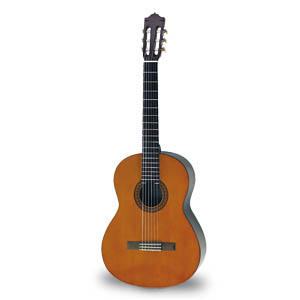
Chris Weinkopf of the Daily News opinion section brought in this Yamaha C45R classical guitar, shown at right, which I strung for him with D'Addario Pro Arte strings. It seems to be the same as the Yamaha C40, but perhaps a special model for Costco, where he bought it.

Anyway, it's pretty good for $99. Yamaha does a surprisingly good job with these inexpensive acoustic guitars, which are made in China. About a year or so ago, I picked up a Yamaha FG-403S from Guitar Center for $199 -- it's a steel-string flatttop guitar with a solid spruce top. Now the C45 (like the C40 before it) does not have a solid top (what do you expect for $99?) but it does have a Javanese rosewood bridge and fingerboard. It's interesting that Indonesia is a now source of rosewood (going from Brazil to India and now Java.) The back and sides are Indonesian mahogany (probably laminated, as is the top (of undertermined wood).

I didn't get a whole lot of time with it, but from stringing it, I noticed that the holes in the bridge and the tuners were a bit narrow -- not a problem, because they will hold the strings tighter as well as provide a cushion for wear -- those holes will only get bigger as strings are taken in and out over the years.

Still, you can get a whole lot of guitar for $99. Yamaha guitars seem to be very traditionally built -- these acoustics all have set necks and fairly standard construction. Nice guitars to learn on -- and to take just about anywhere without worrying too much.

Now I'm not a member of Costco (can't justify spending $40-something for the privilege of buying stuff I don't need in amounts I can't store), but if you know anybody who is, you just might want to ask them to order one or two for you. Also, Costco has one of the best return policies around -- they will usually take a return with no questions asked, although in this case I doubt you'e need or want to give the guitar back.

No doubt, a solid top will sound better, but I bought my Yamaha as a beater, and since it's so nice, I haven't been beating it around enough. It's probably better to buy the guitar used and already abused. I did that with my Goya classical, and now the back's coming loose. It's just not a good idea to leave guitars in the trunks of cars -- the dranatic temperature changes will really loosen things up. That's why everybody needs a beater or two. Gotta see what I can find out there for $free to $25.

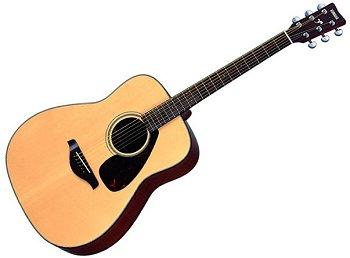
For those looking at good, cheap acoustics, Yamaha has a new line out, the Acoustic FG series, at right, with a nice range of models starting at $279, including six- and 12-strings, plus acoustic-electric. Here's a Musician's Friend review of the new guitars (predictably positive, since they're selling them, but it's some information to consider nonetheless).

To my ears, the Yamahas don't sound like Martins, they certainly don't sound like Taylors. These are just good working guitars that sound ... like a guitar. And the necks are very comfortable. My friend Bruce just bought a Takamine steel string (can't remember the model) for $200, and it sounds and plays pretty well, but the neck is a bit chunky (not that I'm not used to that, coming from the substantial neck of my Fender Lead I solidbody). I just got used to the comfortable neck of the Yamaha, which is that much easier to play because of its matte finish (the rest of the guitar is glossy).

Tuesday, September 20, 2005

Ted Greene and Cathy Segal Garcia


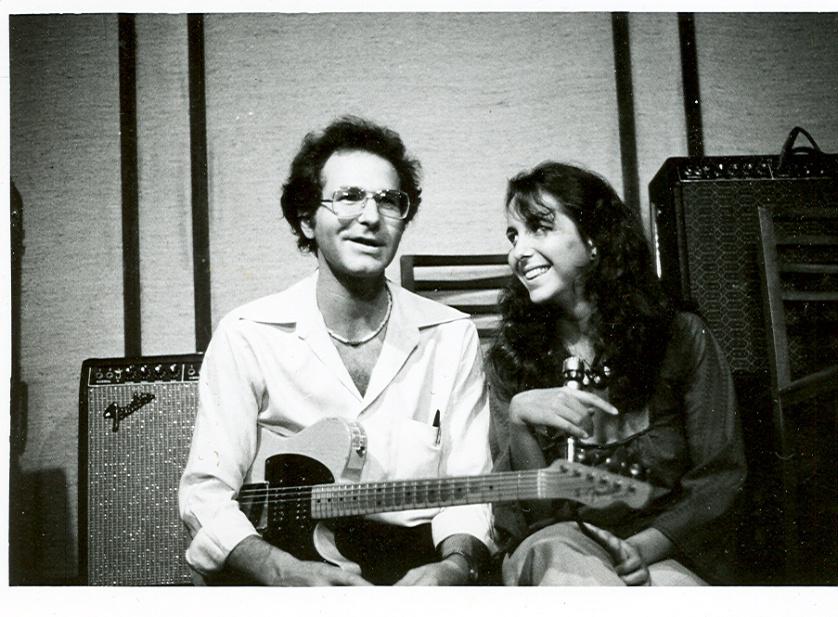
Cathy Segal Garcia, one of L.A. best-known jazz singers and probably its most popular vocal instructor, tells on the Ted Greene Tribute Page about how she met Ted when she was a waitress at the famous Donte's night club (the site of many great jazz performances, and where I saw George Van Eps and Grant Geissman as a teenager). The cool photo above, from the Ted Greene Flickr archive, is from the period when they gigged together in Studio City.

Here is what Cathy wrote:

I came to Los Angeles when I was 21. I had come from a jazz-musical background, I was mainly a singer, and had attended Berklee, where Ted's name floated around the guitarists...that was 72-75. When I got here I waitressed at Donte's, the main jazz club in LA at the time. Ted was there one nite...happened to faint because the music volume bothered him! (you guys know how Ted felt about music volume!) We became friends and when he found out I sang, he suggested getting together... We did, and started rehearsing; we modulated every song at the bridge! Then we were ready for a gig...I put up about 4 or 5 signs at some music stores. I convinced David Abhari from the Sound Room in Studio City to let us play, we were one of the first live bands to play there. I showed up to my first gig in L.A. that nite...to a packed house...no standing room left! We played that club once a week for a year...


One time we were hired for a private party in the Hollywood Hills. About 3/4 way through the party people stopped partying and sat down and listened to the rest of the gig.....That happened more than once!

Words are just words...what they signify is important. To say that Ted was kind and full of humor brings to my mind and body the warmth that Ted, the spirit, is. Ted, the spirit, is not dead and will never die. He has and continues to affect thousands of people because of the quality of livingness that he put out into the world. To not be able to hug him or see the whole package, body and all, is so very sad. But I can visit Ted whenever I want to. He has affected me. Beautifully. What more in this lifetime could anyone want?
Love, Cathy Segal-Garcia

Tuesday, September 13, 2005

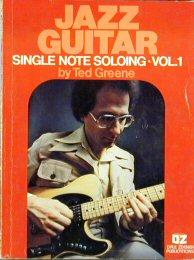
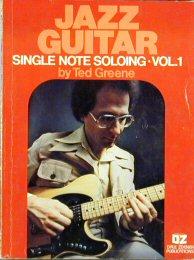
Ted Greene's "Jazz Guitar: Single Note Soloing -- Volume 1"

There's always an argument in methods of jazz improvisation over how much of a role learning, using and thinking in terms of the modes of the major and minor scales should play in figuring out how to hit the right notes when soloing over jazz chord changes.

The whole thing is very Zen: You're supposed to do all this theoretical work on scales and modes, master it and then "not think about it" while you're playing and let the music spontaneously flow.

Some people think it's about learning a language: When you speak English (if it's your first language), you don't think about grammar when you converse, and there aren't even that many pauses between words. You just convey your thoughts in a continuous stream of sound. And that's the same principle in jazz improvisation. You've gotta learn the language of jazz. And just as phonics competes with "whole language" in the teaching of reading, there are a ton of ways to skin the cat in jazz music.

Anyhow, back to Ted Greene's "Jazz Guitar: Single Note Soloing." Ted's focus is on arpeggios, scales and written-out examples, or licks, using that primary material. For him, playing over standard changes is all about chord tones, hence the primary importance of arpeggios (chords broken up into their single notes).

To make your music "sound like jazz," and to learn the musical language, there are several theoretical constructs that will help you wrap your brain (and fingers) around it, and while Ted mentions modes at various points, as well as situations where you could theoretically be using modal thinking to play over diatonic (major and minor) harmony, he doesn't recommend it. Even if you are playing the same notes over two different chords, it's best to think of the harmony you are in, as opposed to some modal construct that requires too much mental work and provides no clue as to which notes are more important than others.

I was looking at Vol. 1 of Ted's book, and as far as scales go, he wants you to directly think of a scale or two that directly relates to the chord you will be playing it over (here related to the major scales for purposes of figuring out the notes):

Major 7th chords

Major (as in C D E F G A B C) scale
Lydian (major with #4) scale

Minor 7th chords

Minor 7th scale (major with b3 and b7)

Dominant 7th chords

Dominant 7th scale (major with b7)
Overtone dominant (major with #4 and b7, also known as lydian dominant)
Two flavors of "altered dominant," which I don't quite have MY head wrapped around.

Along with the many, many arpeggio grids, these scales, with the accompanying "jazzy" examples, will get you playing over just about all the chords you will encounter in jazz. Not that I'm anywhere near being able to do this, at least (in my own mind) I understand what's required.

Also introduced in Vol. 2, along with how to play over fast changes, plus work on the harmony in standard tunes, are many more scales (including diminished, whole tone and harmonic and melodic minor) and arpeggios. It's very interesting to see the order in which Ted introduces each piece of the jazz puzzle and compare it with the rest of the improvisation method books I have on my shelf.

Somewhere in the two "Single Note Soloing" books, Ted writes about converting the material for other instruments, something I wish he had done in his lifetime, because his way of thinking about music transcends the guitar itself in deep and profound ways.

A Ted Greene encounter

Here's a great story about one guitarist's encounter with Ted Greene:

"Ted Greene," by Scott Detweiler
Photo by Pete Huggins from a seminar at California Vintage Guitar and Amp in Sherman Oaks.

Scott really captures the feel of what it was like to see Ted play after years of knowing him only through his books and sole CD. There's an added dimension to meeting a legend when the person you're in front of is not known to anybody else in the room, somebody who most guitar players knew about and were in awe of, yet who was humble about his importance and impact.


In this anecdote, Ted is playing at a gallery opening. From what I read, he liked the kind of gigs where the music could be construed as background. He could pull out an extremely diverse selection of tunes and weave them together in creative ways, all the while REALLY connecting with a few in the room who had never heard a guitar played like that before. Playing solo guitar at that level, with such command of the fingerboard and the harmonic and melodic language of jazz (and music in general) is rare indeed -- and definitely something to aspire to.

Tuesday, August 30, 2005

Leavitt vs. the CAGED system

Leavitt, in "Modern Guitar Method" is not CAGED. For those who don't know, the CAGED system is based around the open-string "cowboy chords" in the first position, building scales and arpeggios off of these shapes -- the C, A, G, E and D major chords, moving them up and down the fingerboard to hit every other key. Worked for Joe Pass and plenty of others. Is Leavitt too complicated to be useful? Does the CAGED system rely too heavily on visualizing shapes and not enough on note awareness?

You can't get away from either one. The guitar is a visual instrument. You're going to see patterns -- they're there, and you can't avoid them. But coupling the visual and technical with genuine note awareness is key, I believe, to mastering the instrument and to musicality in general.

As far as note awareness goes, I think I'm solid up to the 8th fret, and everything on the 12th and later is just a repeat of the open strings and the lower frets, so it's the 9th through 12th frets where I need the most work. Thinking of the 11th fret as a half-step below the 12th makes that one easier. Just playing everywhere on the neck is the way to get around this, and that is where Leavitt is useful. By Vol. 3, you are all over the fingerboard -- that's when you really start hitting his method of position playing. It's a bit boggling, but for major scales, you can basically call on a Leavitt fingering to play in all 12 keys without moving from a six-fret area (as I've said previously, he calls for lots of 1st- and 4th-finger stretching).

Whether or not you could ever identify all of these ways to play a major scale, Leavitt Vol. 3 gives you quite a sight-reading and position-playing workout, playing through all keys in a single position and playing in a single key all the way up and down the fingerboard. It's a difficult but potentially rewarding way of learning the entire guitar and getting the sounds you want from as many places as possible.

One thing about Leavitt that causes controversy is all the stretching that's involved. I think some players just don't want to do all that 1st- and 4th-finger stretching, and there are plenty of fingerings that avoid it. Shifting positions also does this. Jimmy Bruno's "Six Essential Fingerings" also shies away from those stretches. And I remember seeing something in Just Jazz Guitar magazine that pushes note awareness and forbids the visualization of scale fingerings entirely (don't know how that one works).

I honestly don't know what's best here, but knowing the notes AND having some muscle memory as to how to make them can't hurt.

Leavitt on chords

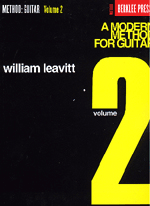
Leavitt's Vol. 2 is heavy on chord forms, even though "Modern Guitar Method" isn't billed as a chord book. It is known for it's reading and scale work, but there are tons of chord forms, some in Vol. 1 but many more in Vol. 2 that can really improve your comping. He doesn't get into any heavy talk about voice leading, instead saying something like "smooth rhythm guitar is made possible by knowing as many chord forms as possible." That's true. I struggle with voice leading myself, and for the guitar, I do think it's a matter of figuring out and using more chords, letting the ear help you figure out which voicings lead best from one chord to the next.